
Book Appointment
Gwalior
- Gwalior is a city in Madhya Pradesh, India, lying 76 miles (122 km) south of Agra, and known as the tourist capital of Madhya Pradesh.
- Gwalior occupies a strategic location in the Gird region of India, and the city and its fortress have served as the center of several of historic northern Indian kingdoms.
- That the location of the city still is considered militarily important is signaled by the presence of a major air force base at Maharajpura.
- According to local tradition, Gwalior owes its name to a sage of former times. SurajSen, a prince of the Kachhwaha clan of the eighth century, is said to have lost his way in the jungle.
- On a secluded hill he met an old man, the sage Gwalipa, whose influence almost took him by surprise. Upon asking the sage for some drinking water he was led to a pond; the waters not only quenched his thirst but cured him of leprosy.
- Out of gratefulness, the prince wished to offer the sage something in return, and the sage asked him to build a wall on the hill in order to protect the other sages from wild animals which often disturbed their yagnas (or pujas).
- SurajSen later built a palace inside the fort, which had been named "Gwalior" after the sage; eventually the city which grew around the fort took the same name.
- Gwalior is well connected by train services to all parts of the country, including 4 metros. There are direct trains to Mumbai, Delhi, Kolkata (Howrah), Chennai, Trivandrum, Indore, Jaipur, Udaipur, Ahmedabad, Pune, Jammu, Lucknow, Bhopal, Bangalore and other major towns.
- Gwalior is the main station serving most of the important and long distance trains. Gwalior lies on the longest functional broad gauge line in India between Delhi and Mumbai.
General Information of Gwalior
- Gwalior may have been held by the Guptas or some of their subordinates, but the oldest historical evidence shows the fort was conquered by the Hunas in the early sixth century.
- From inscription found such as Rakhetra stone inscription, scholars assert that Gwalior was under the possession of Gurjara Pratiharas till at least 942-43 A.D.
- In the 10th century, after Gurjara Pratiharas, Gwalior was taken by the Kachwaha Rajputs. Qutb-ud-din Aybak captured the city in 1196. Shamsud-din Altamsh took control of the area in 1232.
- By the 15th century the city had a noted singing school which was attended by Tansen. It first fell to the British in 1780, but was one of the cities taken during the Sepoy Rebellion.
- Today Gwalior includes the former city of Lashkar. Laskar was the capital of Gwalior state, one of the princely states of India during the British Raj. It then served as the capital of Madhya Bharat from 1950 to 1956.
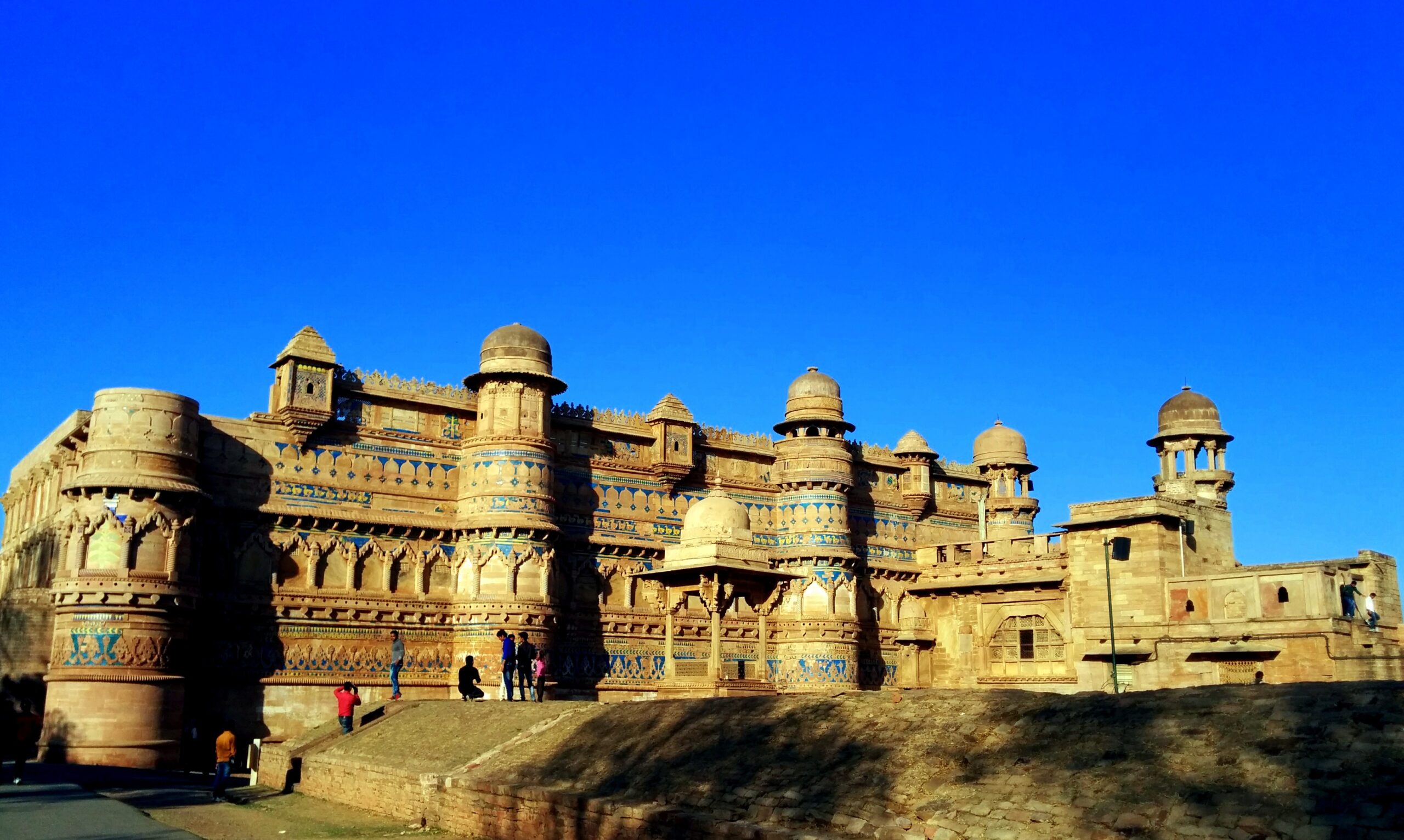
- At the heart of Gwalior is Gwalior Fort, built by Raja Man Singh Tomar, of the Tomar dynasty. This formidable structure was reputed to be one of the most invincible forts of India.
- It occupies an isolated rock outcrop. The hill is steepened to make it virtually unscalable and is surrounded by high walls which enclose buildings from several periods. The old town of Gwalior lies at the eastern base of the fortress.
- Lashkar, formerly a separate town that originated as a military camp, lies to the south, and Morar, also a formerly separate town, lies to the east. Gwalior, Lashkar and Morar are presently part of Gwalior Municipality.
REVOLT OF 1857
- Gwalior is also known for its share in 1857 revolt mainly due to Rani Lakshmi Bai’s heroic resistance and death.
- After Kalpi (Jhansi) fell into the hands of the British on May 24, 1858, Lakshmibai sought shelter at the Gwalior fort. The king of Gwalior was not willing to give up his fort without a fight as he was afraid of the British.
- But the soldiers laid down their arms in respect for the Rani of Jhansi. Thus the freedom fighters entered Gwalior without a fight.
- The British wasted no time in attacking Gwalior. It was the fiercest, bloodiest battle ever fought on Indian soil.
- Lakshmibai’s courage, strength, and ability as she valiantly fought the British army’s vastly superior forces, are remembered to this day. She dies fighting and Gwalior was captured. Tantya Tope was hanged and Rao Sahib escaped.
ART AND CULTURE
- Gwalior is a well acknowledged place of art, associated with historic as well as contemporary evidence.
- In August 2005 a mural created by Aasutosh Panigrahi and five other artists was acknowledged as World’s Largest Indoor Mural by the Guinness Book of Records.
- Gwalior holds an unparalleled reputation in Sangeet. Greatest ever classical singer (Dhrupadiya) was Baijnath Prasad alias BaijuBawra, who lived in Gwalior for his whole life under the patronage of Man Singh.
- Baiju was born in Chanderi and was cremated there only, got the training of music in Brindaban under great Swami Guru Haridasji. He was Court Musician of Gwalior along with NayakCharju, Bakshu, and others.
- Tansen, born in Behat, trained in music at Vrindavan, served Raja RamchandraWaghela of Bandhawgarh, and then went to Agra under the patronage of Akbar. After the death of Tansen in FatehpurSikri and cremation in Agra, the ashes were buried in Gwalior. TansenSamaroh is held every year in Gwalior.
- UstadNatthu Khan, Hassu Khan, Haddu Khan, NissarHussain, Rehmat Khan, Shankarrao Vishnu Pandit, RamkrishnaBuwaVaze, RajabhaiyyaPoonchhwale, KrishnaraoPandit, lived here and spread the magic of music. Renowned artiste Mrs. MaliniRajurkar, who is keeping the flame of Hindustani music alive today, also belongs to Gwalior.
- Sarod Maestro UstadAmjad Ali Khan is also from the royal city of Gwalior. His grandfather Ghulam Ali Khan Bangash became a court musician in Gwalior.
- ‘Late Vijay Singh Akolkar’ (died in 1969) one of the best satirist in that time. He is belonging to shahipariwar (Jhagirdar) Now, one of the great Hindustani classical singers, Dr. Ishwar Chandra Karkare who is fourth generation of artist’s poets and musician family, lives here and his classical music is full of spiritual joyousness.
- Marathi SahityaSammelan, the conference on Marathi Literature was held once in Gwalior city. It was presided by President of the Conference writer KusumavatiDeshpande (and wife of Kavi Anil) in 1961. She was the first female president of the annual Sammelan since its inception in 1878.
- Culturally Gwalior is the confluence of two rich cultures Bundeli and Braj. Bundelkhand covers Gwalior, Bhind, Morena, Sagar, Shivpuri, Guna, Sheopur and adjoining areas.
Ahiri Dance
- This dance is related to people who have traditionally been in the business of cattle herding.
- In different parts of the state these people are known by different castes such as Ahir, Baredi, Gwal, Rawat, Raut, Gwala etc. These people believe that they are descendants of Krishna.
Main Festivals
- All national festivals, Diwali, Holi, MakaraSankranti, Eid-ul-Fitr, Rakhi,Mahavirjayanti and other local ones like Nag-Panchmi, AhilyaUtsav, Ganesh Utsav, GudiPadwa (Marathi new year), Navratri, Dussehara, Durga Puja are celebrated with equal enthusiasm.
- Gwalior also celebrates Rang Panchami quite differently. This festival is celebrated five days after Dulendi or Holi.
- This is also celebrated like Dulendi, but colors are mixed with water and then either sprinkled or poured on others.
- Ganesh Chaturthi is celebrated in a unique way in Gwalior city. People of Gwalior arrange a carnival of floats (known as “Jhanki” in local Hindi language) in various places of city.
- MakarSankranti is a ‘Kite Festival’ on 14 January each year; people fly kites and compete to cut each other’s kites in sky.
Places of interest
Places Of Tourist Attraction in Gwalior
- Gwalior Fort
- Gujari Mahal
- Man Mandir Palace
- Ghaus Mohammaed’s Tomb
- Gurudwara Data Bandhi Chhod
- Gopachal Parvat
- Sarod Ghar
- Jai Vilas Palace
Top excursions in Gwalior
Top attraction of Gwalior :
- Datia
- Sonagiri
- Jhansi
- Madhav National Park
- Tigra Dam





Trips
& tours
Choose M.P Holidays®
- Approved by “The Ministry of Tourism” (Approval No: 2203270HE874)
- “The Official No.1 Channel Partner” of M.P Tourism (Registration No: MP-TOUR-20221/131888)
- We are Awarded “The Best Travel Agent” by M.P. Government for the three consecutive years. (2016, 2017 and 2018)
- Having offices at
- Surat
- Indore
- Ahmedabad
- Pachmarhi
- Nagpur
- Kanha
- Discover Madhya Pradesh from major cities like Surat, Ahmedabad, Delhi, Mumbai, Nagpur, Pune and beyond—experience the best of India, no matter where you start.
- Own resort at Madhya Pradesh.

Certificate of Excellence for Year 2016

Certificate of Excellence for Year 2017

Certificate of Excellence for Year 2018

With Hon'ble Chief Minister Shivraj Singh Chauhan