Explore Bagh Print, a traditional hand-block printing craft from Madhya Pradesh. Discover its history, unique red and black designs, fabric-making process, and where to buy authentic Bagh textiles with MP Holidays.
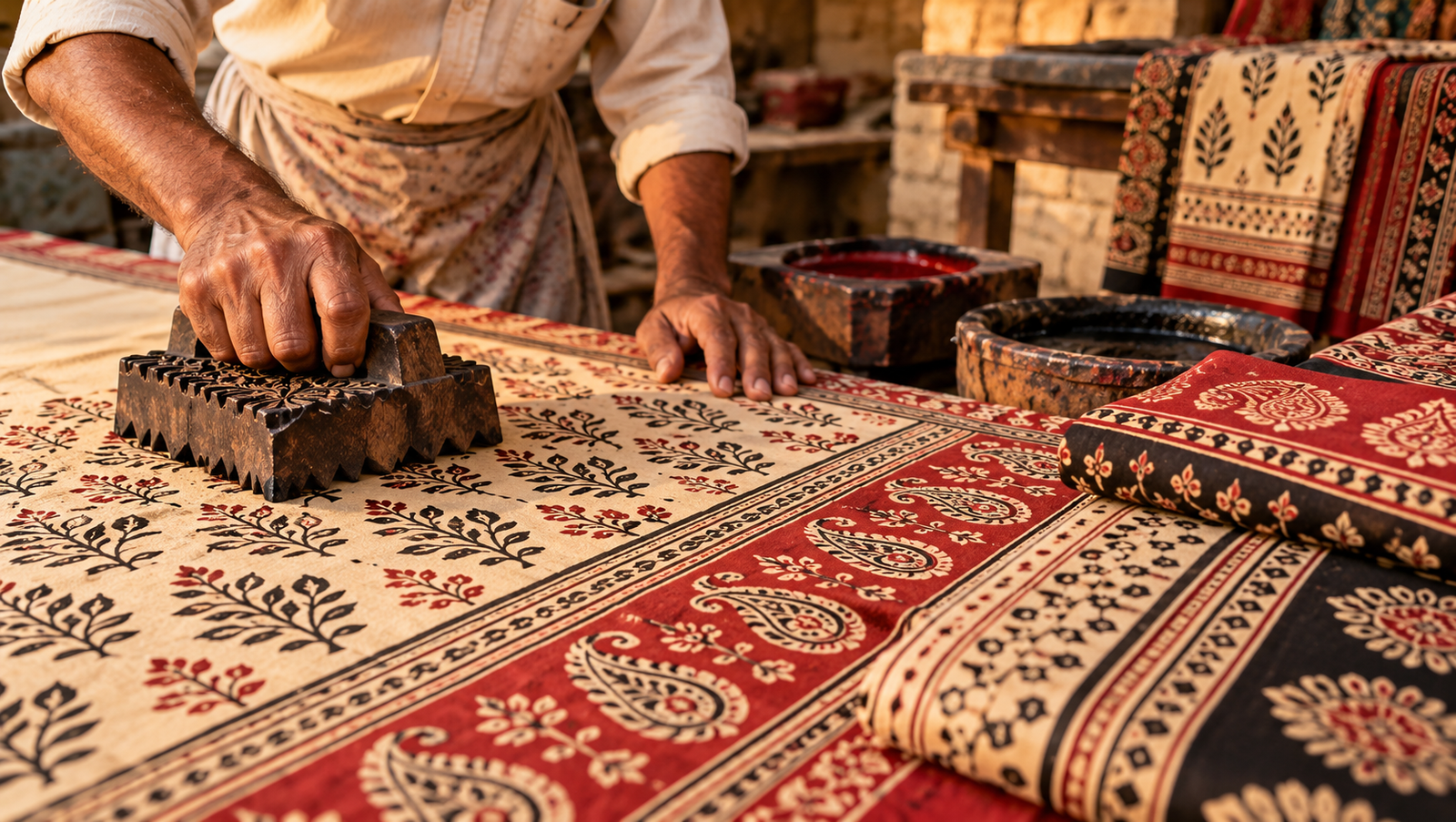
Bagh Print is a traditional hand-block textile printing craft from Bagh village in the Dhar district of Madhya Pradesh. Famous for its distinctive red and black designs, intricate patterns, and natural-dye traditions, this craft represents an important part of India's textile heritage.
Artisans create these prints using hand-carved wooden blocks, carefully prepared fabrics, and a multi-stage dyeing and washing process.
Unlike machine-printed fabrics, traditional Bagh textiles reflect the skill, patience, and experience of the craftspeople who produce them.
Today, Bagh Print appears on sarees, dupattas, dress materials, scarves and home furnishings, making it popular among people who appreciate handmade Indian textiles.
This guide explores the history of Bagh printing, its traditional production process, popular fabrics, distinctive designs, and places where visitors can buy authentic products in Madhya Pradesh.
|
Details |
Information |
|---|---|
|
Craft |
Bagh Print |
|
Origin |
Bagh village, Dhar district, Madhya Pradesh |
|
Craft type |
Traditional hand-block textile printing |
|
Famous colours |
Red, black and natural fabric backgrounds |
|
Printing method |
Hand-carved wooden blocks |
|
Traditional dye sources |
Alizarin-based red dyeing and iron-based black printing |
|
Common fabrics |
Cotton, silk and cotton-silk blends |
|
Popular products |
Sarees, dupattas, scarves, dress materials and home textiles |
|
Geographical Indication |
Registered GI craft |
|
Best place to explore the craft |
Bagh village and artisan workshops |
The history of bagh print in Madhya Pradesh is closely connected with traditional textile printing communities and the cultural landscape of the Malwa-Nimar region.
Bagh village became an important centre for hand-block printing, where artisans developed distinctive patterns and dyeing techniques.
The craft is particularly associated with the Khatri artisan community, whose members helped preserve and develop the printing tradition.
Traditional accounts connect Bagh printing with artisan families who migrated to the region and brought knowledge of hand-block textile printing.
Over time, these techniques developed into a recognisable local style.
The availability of water, traditional dyeing knowledge, and skilled artisans contributed to the craft's growth.
Artisan families have passed down printing skills through generations.
The process requires knowledge of fabric preparation, block alignment, dye chemistry, and washing techniques.
Master craftspeople such as Mohammed Yusuf Khatri and other members of the Khatri community have played important roles in promoting and preserving Bagh printing.
Bagh Prints of Madhya Pradesh have received Geographical Indication (GI) registration.
GI recognition identifies products associated with a particular geographical origin and helps distinguish the traditional craft from unrelated imitations.
For buyers, the recognition highlights the importance of purchasing from genuine artisan producers.
Traditional Bagh textiles are recognised for their bold colour combinations, detailed motifs, and carefully repeated designs.
Red and black are the most characteristic colours of Bagh printing.
The red is traditionally developed through dyeing processes involving alizarin and suitable mordants, while the black is produced using iron-based preparations.
The precise recipes and techniques may vary between artisan workshops.
Artisans use wooden printing blocks carved with detailed patterns.
Each block transfers part of a design onto the fabric.
Complex textiles may require multiple blocks and careful alignment to create the final composition.
Bagh designs feature commonly:
Floral patterns and vines.
Geometric arrangements.
Borders and repeating motifs.
Traditional decorative forms.
Patterns inspired by architectural and natural elements.
The finished textile often combines bold contrast with intricate detailing.
Creating traditional bagh prints involves several stages of fabric preparation, printing, dyeing, and washing.
Artisans begin by washing and treating the fabric to remove impurities and improve its ability to absorb printing and dyeing materials.
Traditional preparation may involve repeated soaking and washing.
The process helps create a suitable base for the designs.
Artisans prepare printing pastes using traditional recipes.
Iron-based mixtures are used to produce black designs, while mordant-based printing preparations help develop red colours during subsequent dyeing.
The ingredients and proportions require careful control.
The prepared fabric is spread on a printing table.
The artisan dips a carved wooden block into the printing paste and presses it onto the textile.
Each impression must align with the previous one.
Repeating the process produces continuous patterns across the fabric.
After printing, the fabric is allowed to dry.
This helps the printed preparations settle before further treatment.
Drying time depends on the weather, fabric, and printing method.
The textile undergoes dyeing or colour-development processes.
Traditional Bagh red is associated with alizarin dyeing, while the iron-based printing develops dark black patterns.
Heat, water quality, and treatment time influence the final appearance.
The printed textile is washed to remove excess dye and processing materials.
Traditional washing may involve repeated rinsing.
The finished fabric is dried and prepared for sale.
The entire process requires skilled craftsmanship and can take several days, depending on the fabric and production conditions.
Bagh print fabric is available in several textile varieties, each suitable for different garments and uses.
|
Fabric type |
Common uses |
Features |
|---|---|---|
|
Cotton |
Kurtas, sarees and dress materials |
Breathable and comfortable |
|
Silk |
Sarees and festive garments |
Smooth texture and elegant drape |
|
Cotton-silk |
Dupattas and ethnic wear |
Combines softness and sheen |
|
Chanderi |
Sarees and dupattas |
Lightweight and often slightly sheer |
|
Home textiles |
Cushion covers and table linen |
Decorative traditional patterns |
Bagh sarees are popular for their distinctive motifs and traditional appearance.
Cotton versions are suitable for everyday and semi-formal wear, while silk and Chanderi versions are often selected for special occasions.
Dupattas are among the most accessible Bagh textile products.
They can be paired with plain kurtas and ethnic outfits to highlight the printed patterns.
Unstitched dress materials allow buyers to create customised kurtas, suits, and other garments.
Before purchasing, check the fabric length, width, and washing instructions.
Travellers interested in authentic textiles can explore artisan workshops, government-supported handicraft outlets and established textile sellers.
Bagh village is the traditional centre of the craft.
Visiting artisan workshops offers an opportunity to see how the printing process works and purchase textiles directly from producers.
Workshop visits should be arranged in advance, as not every production space is open to tourists.
Indore is a practical shopping destination for travellers exploring western Madhya Pradesh.
Handicraft outlets and textile retailers may stock Bagh sarees, dupattas and dress materials.
Availability varies, so buyers should ask whether the products are genuine hand-block prints from Bagh.
Travellers visiting Mandu can explore regional craft shopping opportunities during their trip.
However, Bagh textiles may not be available at every tourist shop.
For a dedicated craft-buying experience, Bagh village or a verified artisan retailer is preferable.
Explore Mandu Tourism for nearby sightseeing ideas.
State-supported handicraft outlets may offer textiles from recognised craft traditions.
Ask about the product's origin, artisan, and hand-printing process before purchasing.
Traditional hand-block printing has characteristics that can help buyers distinguish it from mass-produced printed fabrics.
Slight variations: Hand-block printing may show minor differences in alignment and colour intensity.
Detailed motifs: Look for carefully repeated patterns and traditional designs.
Fabric quality: Examine the textile's texture, weave, and finish.
Artisan information: Ask about the producer and where the fabric was printed.
GI documentation: When available, request credible information about geographical origin.
Minor irregularities can indicate handwork, but they are not proof of authenticity. Machine printing can imitate these features.
|
Feature |
Traditional Bagh Print |
Machine Printing |
|---|---|---|
|
Printing method |
Hand-carved wooden blocks |
Mechanical or digital printing |
|
Production |
Artisan-led |
Machine-led |
|
Pattern alignment |
May have small variations |
Usually highly uniform |
|
Colour process |
Traditional dyeing and printing techniques |
Depends on industrial process |
|
Craft heritage |
Associated with Bagh artisans |
Not necessarily linked to Bagh |
|
Production time |
Often longer |
Generally faster |
Proper care helps preserve the appearance of hand-printed textiles.
Wash delicate pieces separately, especially during the first few washes.
Use mild detergent and avoid harsh bleaching agents.
For silk, Chanderi, or expensive garments, follow the seller's recommended cleaning method.
Dry fabrics away from prolonged direct sunlight to reduce the risk of fading.
When ironing, use a temperature appropriate for the fabric.
Bagh printing can be explored as part of a broader journey through western Madhya Pradesh.
Travellers interested in culture and heritage can combine craft shopping with sightseeing in Indore, Mandu and Maheshwar.
Indore offers city attractions and shopping, Mandu is known for its historic monuments, and Maheshwar is famous for its handloom weaving traditions.
Explore Indore Tourism or consider the Indore Ujjain Maheshwar Mandu Tour Package with MP Holidays.
A dedicated visit to Bagh village should be planned separately according to available travel time and workshop arrangements.
Bagh Print is an important part of Madhya Pradesh's traditional textile heritage.
Its distinctive red and black patterns, skilled wooden-block printing, and detailed dyeing techniques make it a recognisable Indian craft.
From cotton sarees and silk dupattas to dress materials and home furnishings, Bagh textiles offer a combination of traditional craftsmanship and contemporary usability.
Visitors interested in experiencing the craft can explore artisan workshops in Bagh village or purchase authentic textiles from reputable sellers.
Discover the crafts, culture, and heritage destinations of Madhya Pradesh with MP Holidays.
Tell us your dates and we will send a custom itinerary. Free quote, no obligation.
Everything travellers ask us most often. Still unsure? Message us on WhatsApp and a real MP Holidays expert will reply.