
Up to 600 caves in the Vindhya ranges, of which twelve are open, holding some of the oldest paintings in the world.
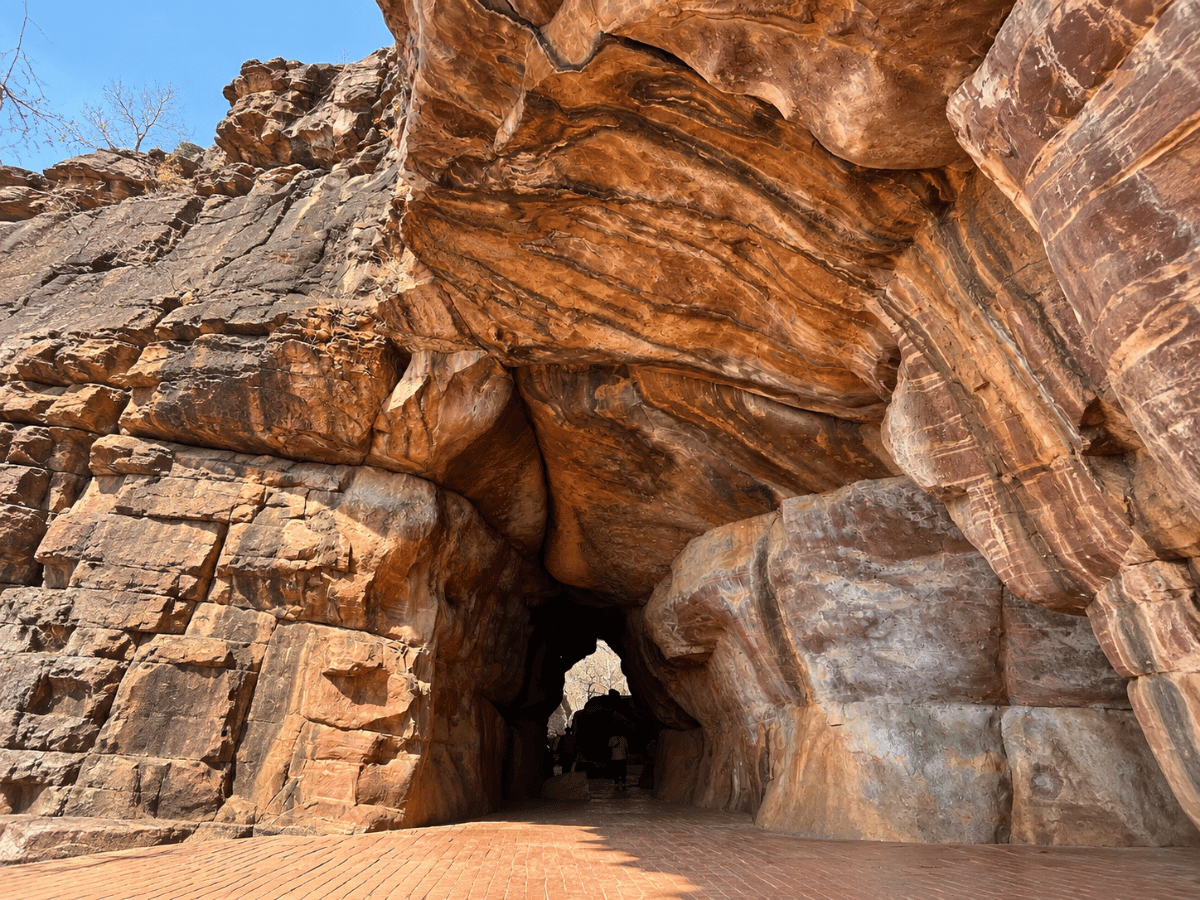
The Bhimbetka caves lie in Madhya Pradesh, bounded by the Vindhya ranges. They were the dwellings of prehistoric people and hold paintings running from the Palaeolithic to the medieval period, together showing the progression of the human race over time. There are as many as 600 caves here; only twelve are accessible to the public, and those contain some of the oldest paintings in the world. The work invites comparison with the indigenous rock paintings of Australia, the cave paintings of Lascaux in France and the Bushman paintings of the Kalahari. Concealed among teak and sal forest in weathered crags, the caves were discovered by V S Wakankar in 1957. The sandstone walls carry primeval paintings and symbols portraying the daily life and ethnicity of Stone Age people, all of it classified into seven categories. The styles of the different periods differ so clearly that one can easily tell them apart: huge linear figures of bears, tigers and rhinoceroses belong to the Palaeolithic, and over time the paintings became smaller and more inventive. Some of the work dates back around 12,000 years, and the natural red and white pigments have kept their vibrancy. The site makes a good day long outing.
Of the roughly 600 caves here, twelve are open to the public, and they hold the paintings the site is famous for. Doing all twelve properly rather than the first three is what makes the trip worthwhile.
The caves are cut into sandstone in weathered crags, hidden among teak and sal forest. The rock formations themselves are a large part of the walk, and some of them are as memorable as the paintings.
Red and white pigments drawn from natural sources have kept much of their original strength, which is why work around 12,000 years old is still legible on open rock.
Bhimbetka is a day long outing, roughly 45 km east of Bhopal, and is walked on a marked route between the open caves.
November to February is the best window for a day on foot here. The forest is at its greenest after the monsoon, though the rock gets slippery while it is raining. Avoid the summer middle of the day entirely, as there is almost no shade on the walking route.
Everything travellers ask us most often. Still unsure? Message us on WhatsApp and a real MP Holidays expert will reply.