
Jain Tirthankara statues cut into the slopes of Gwalior Fort, led by a 47 foot Parshwanath on a lotus.
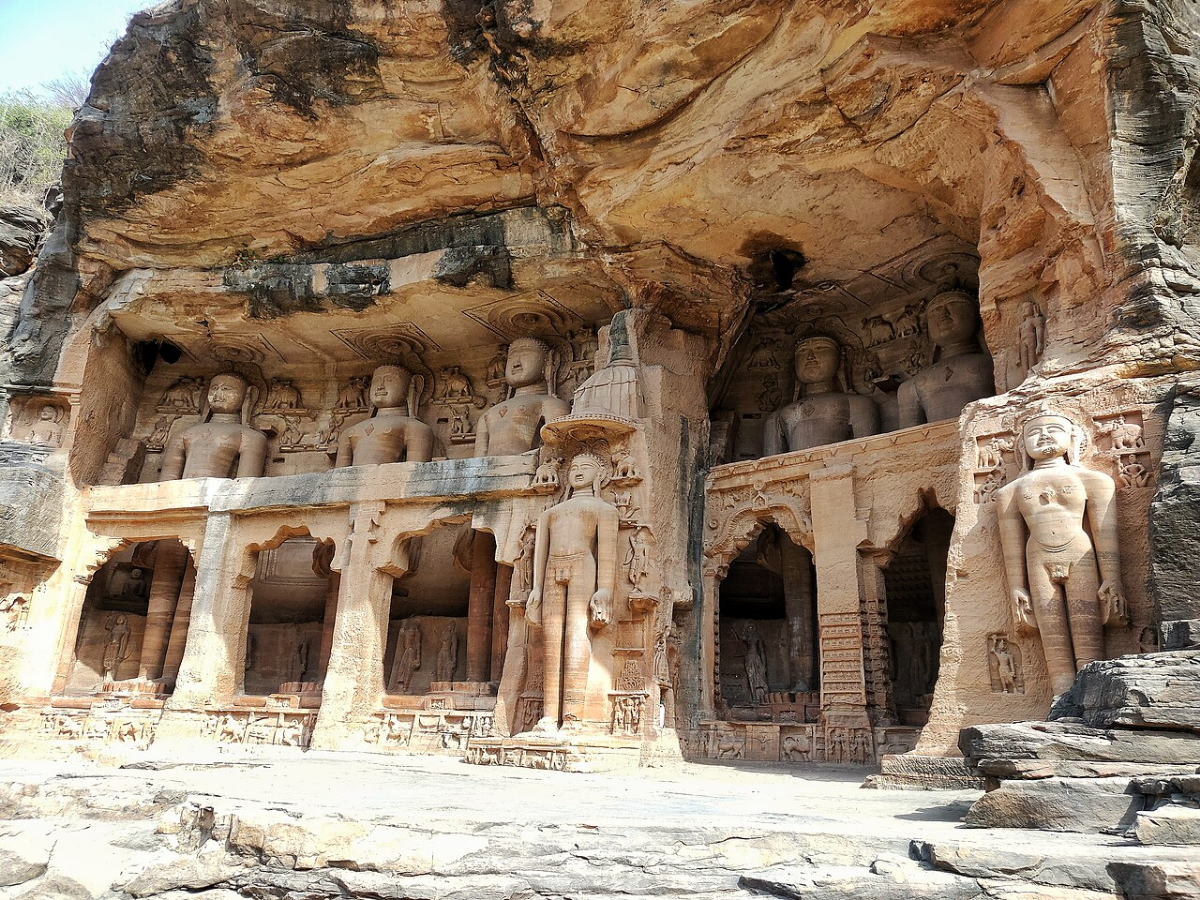
Gopachal Parvat lies on the slopes of Gwalior Fort and carries a remarkable set of Jain Tirthankara statues cut from the hillside. The largest is the idol of Bhagwan Parshwanath seated on a lotus, 47 feet high and 30 feet wide, and said to be the largest such statue carved from a single piece of stone anywhere.
Twenty six Jain statues stand in a series along the slope, which gives the site its character: not one monument but a sequence that unfolds as you walk. They were made between 1398 and 1536 under the Tomar kings, and together they are both a feat of carving and a record of Jain patronage at Gwalior.
The seated figure of Bhagwan Parshwanath on a lotus is 47 feet high and 30 feet wide, cut from a single piece of stone. Standing at the base and looking up is the only way to register the scale, and the lotus seat alone is larger than most complete sculptures.
Twenty six Jain statues follow one another along the rock, forming a continuous picture rather than separate monuments. Walking the line in order, rather than photographing the biggest and leaving, is what the site is designed for.
The statues were carved between 1398 and 1536 under the Tomar kings. That span of nearly a century and a half shows in the work, and comparing figures from different parts of the sequence rewards a slower visit.
Gopachal Parvat is on the fort slopes, reached by a path, and is a place of Jain worship as well as a monument.
October to March is the right season for the walk up the slope. Early morning is the best hour, both for the light on the rock faces and for the quiet. Jain festival days bring large numbers of pilgrims to the site.
Everything travellers ask us most often. Still unsure? Message us on WhatsApp and a real MP Holidays expert will reply.